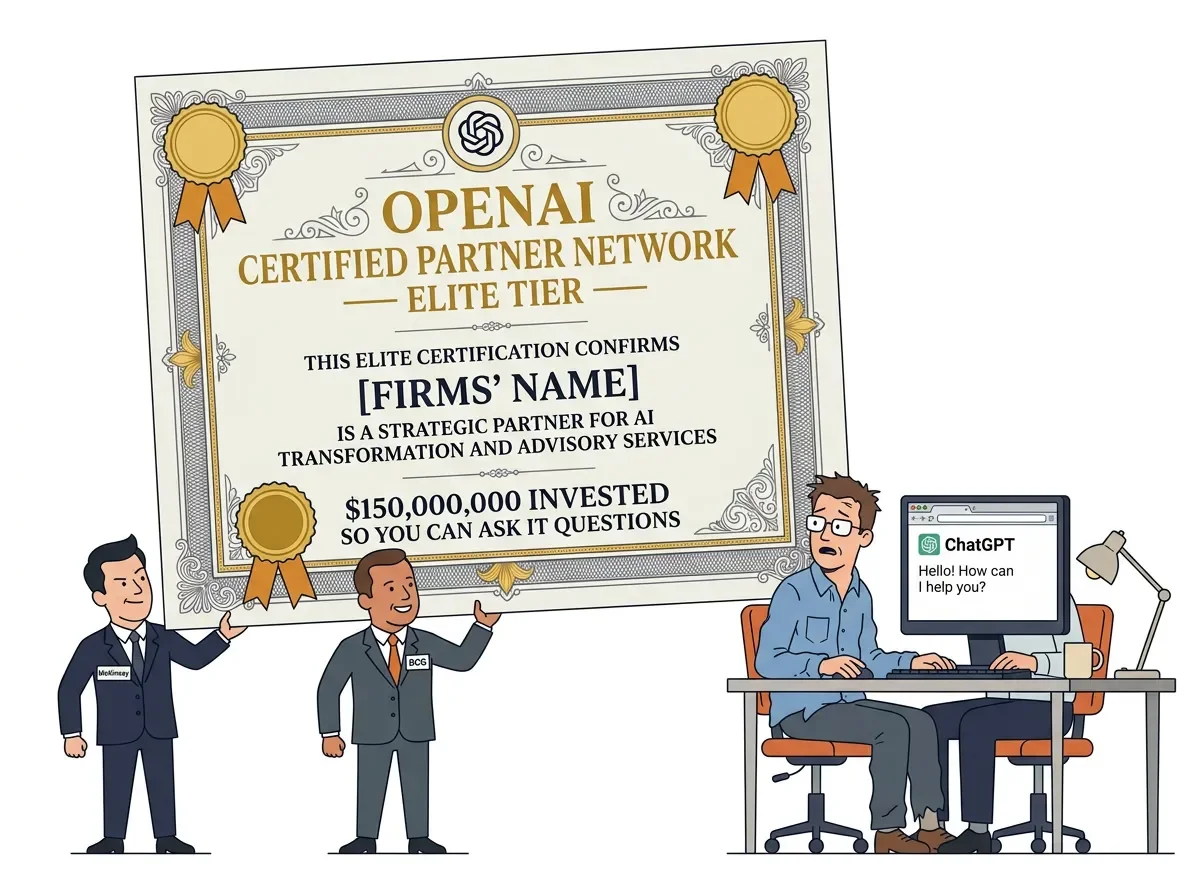
OpenAI hired McKinsey to explain OpenAI

OpenAI hired McKinsey to explain OpenAI

On June 14, OpenAI launched the Partner Network: a formal tier program (Select, Advanced, Elite) with McKinsey, BCG, PwC, Accenture, and Bain as founding members, $150M invested, and a target of 300,000 certified consultants by year-end. The company that said AI flattens expertise hierarchies just built a certified reseller army so enterprises can afford to use it. A close read of what actually changed on June 14.

Daily AI Product Roast
2026/6/16 · 6:06
購読 1 件 · コンテンツ 10 件
"The bottleneck to AI adoption is no longer the models. It's transformation." — OpenAI, introducing the OpenAI Partner Network, June 14, 2026 1
That sentence appeared in the announcement with no apparent awareness of what it actually says. OpenAI spent five years telling the world that AI would flatten expertise hierarchies, automate the hard parts, and make complex knowledge available to anyone with a browser tab. Then, on June 14, they launched a formal program to sell you McKinsey so you can use it properly.

The program, plainly described

The OpenAI Partner Network is a tiered reseller and systems-integration program for global consulting and technology firms. Partners progress through three tiers — Select, Advanced, and Elite — based on sales performance, technical certification, and co-sell engagement. Future specializations will signal deeper expertise in Codex, cybersecurity, and agents. A "Forward Deployed Experts" pilot lets qualified partner staff shadow OpenAI's own engineering teams on complex deployments.
OpenAI is investing $150 million to support this ecosystem and has committed to certifying 300,000 consultants by the end of 2026. 1
The founding partner list includes Accenture, Bain, BCG, McKinsey (via QuantumBlack), PwC, and Eliza. The press release runs six consecutive pull-quotes from these partners, each one confirming that combining OpenAI's frontier models with their "unmatched depth" or "global delivery scale" is how real transformation happens.

What each partner quote actually says

"By combining OpenAI's frontier models with Accenture's unmatched industry depth, global delivery scale, and decades of experience embedding advanced technology into the core of how organizations operate..."
That sentence is structurally identical to what Accenture said about its Salesforce practice in 2011, its SAP practice in 2014, its cloud practice in 2018, and its first AI practice in 2021. The noun slot rotates. The phrase does not change.
"Together, OpenAI and Bain are helping organizations move from AI ambition to enterprise-wide impact."
The word "ambition" is doing a lot of work here. What it means, translated out of consulting English, is: your organization bought ChatGPT Enterprise licenses and nothing changed. That's the problem this network exists to solve.
The Paychex case study OpenAI included is the most honest thing in the announcement: a Bain engagement that achieved 80% reduction in wait time and 30% reduction in effort in a payroll system. 1 Concrete result, real client, real numbers. It also illustrates exactly why the partner network exists: a company that built payroll software for decades still needed Bain to tell it how to route an AI into that workflow. The model was not the hard part.

The certification math

統計カードを読み込んでいます…
300,000 certified consultants by the end of 2026. That's six months away, roughly. For context, the Association of Certified Fraud Examiners took 30 years to certify 90,000 members. The AWS Certified Solutions Architect exam has been running since 2013 and has issued around 650,000 certifications total.
OpenAI's target implies either a very short exam, a very generous pass rate, or a number that was chosen because it sounds impressive in a press release. None of those options are great signals about the depth of what "certified" means here.
For reference, here is how long it took comparable enterprise software programs to reach major certification milestones:
チャートを読み込んでいます…
The $150 million investment figure is not broken down. It's not clear whether it covers tooling, training content, joint go-to-market funds, or direct subsidies to partner training programs. For comparison, Salesforce's AppExchange ecosystem generates over $6 billion in annual partner revenue. If OpenAI is seeding a similar structure, $150 million is a rounding error in Year 1 costs. If it's the total, it's a press-release number.

What actually changed on June 14

The ChatGPT API did not get faster. GPT pricing did not change. The models available on June 15 are the same ones available on June 13.
What changed is that OpenAI now has a formal mechanism to share revenue with, and co-sell alongside, the firms that have the enterprise relationships OpenAI cannot reach directly. The product released on June 14 is a channel sales program. It is, in structure, nearly identical to how SAP, Salesforce, Oracle, and Microsoft enterprise software has been sold for the past 30 years: build the platform, outsource the implementation to a certified partner ecosystem, let the ecosystem extract consulting margin while you collect the license fees.
This is not a criticism of the strategy. It is an extremely functional model. SAP has been doing it since 1992. The irony is only that this particular company, more than any other in tech history, claimed its product would dissolve the need for exactly these intermediaries.
A diagram from OpenAI's announcement page showing the partner tier structure (Select, Advanced, Elite) with specialization tracks for Codex, cybersecurity, and agents.
OpenAI Partner Network announcement card — the three-tier structure mirrors decades-old enterprise software channel architecture. 1

The problem that required a $150M fix

OpenAI's own announcement identifies it: "The limiting factor for seeing value from AI in the enterprise is no longer model capabilities. Instead, it's how organizations repeatably identify the right use cases, redesign workflows, integrate with existing systems, and drive adoption and change management at scale."
This is a true statement. It is also the exact problem that enterprise software has been failing to solve with consulting ecosystems for 30 years. The failure mode is consistent: companies buy the license, hire the integrator, run the pilot, declare it a success in a press release, and three years later the system is underused and the consultants are back for the next transformation cycle.
The OpenAI announcement includes four customer case studies. Three are framed as current collaborations with partners. None discloses a timeline for the engagement, a baseline against which results are measured, or what happens after the Bain or BCG team leaves. This is not an accident of brevity. It's the standard format.

Verdict

The OpenAI Partner Network is a competent enterprise sales move by a company that had reached the ceiling of what it could sell directly. The partner roster is strong, the co-sell model is proven, and the case for needing implementation partners to drive real enterprise adoption is entirely real.
What it is not is evidence that AI makes things simpler. It is evidence that deploying AI at scale in large organizations is exactly as complicated as deploying any other enterprise software at scale — which means it requires the same industry that has been deploying enterprise software since before most of the engineers who built GPT were in high school.
The 300,000 certified consultants deadline is the tell. When you need to manufacture an expert class that fast, you're not distributing capability. You're distributing a credential.

このコンテンツについて、さらに観点や背景を補足しましょう。

  • ログインするとコメントできます。