
The $1,750 ceiling: dental and vision coverage moves for June 15, 2026
MassHealth's new $1,750 dental cap (effective August 1, 2026) puts a single crown on a collision course with your annual limit. This issue also updates the Delta Dental antitrust front (four new state class actions), embeds six community billing stories from the past week — including an SF upselling thread and a dual-coverage credit-hold trap — and rounds out the toolkit with June 2026 procedure benchmarks and a DentalPlans.com flash sale.

The most consequential dental story this week didn't come from a private insurer. MassHealth — Massachusetts's Medicaid program — quietly posted an update confirming that starting August 1, 2026, adult dental benefits for members 21 and older will carry a $1,750 annual coverage limit. 1 Previously, there was no explicit annual cap. The first benefit year (BY2027) runs from August 1, 2026 to June 30, 2027 — an 11-month short year — with subsequent years running July 1 to June 30. Members under 21 and clients of the Department of Developmental Services are exempt.
The Health Safety Net, which covers dental services for low-income uninsured adults in Massachusetts, gets its own $1,750 combined dental limit starting July 1, 2026. 1 Dental implants remain excluded from MassHealth coverage entirely; bone grafts may be covered as a medical service with prior authorization.
The page uses "anticipated" throughout — suggesting the policy hasn't reached final regulatory confirmation — but the language and effective date are specific enough to treat as a planning reality for any affected member. If you receive MassHealth Standard, CommonHealth, Family Assistance, or CarePlus and you're 21 or older, any major dental work scheduled after August 1 now counts against a $1,750 ceiling. A single porcelain crown runs $800–$2,500 at private practices in the US. 2 That cap can disappear in one procedure.
Delta Dental litigation keeps expanding
The antitrust front against Delta Dental widened in two directions since the channel's last coverage. On April 30, 2026, dentists filed state-level class actions in California, Wisconsin, Michigan, and Massachusetts, alleging that Delta Dental suppressed reimbursement rates and limited competition in each state's insurance market. 3 The state filings followed a setback in federal court: a national class certification in the 2019 MDL was denied by an Illinois federal judge in September 2025, and the Seventh Circuit declined to immediately review that decision in December 2025. Plaintiffs who couldn't revive a federal national class turned to individual state courts instead.
A separate federal case against Delta Dental of California was filed on May 31, 2026, in the U.S. District Court for the Western District of Washington (case 2:26-cv-01876). 4
These cases collectively assert Delta Dental's market share exceeds 50% in the affected states — a threshold typically relevant to antitrust analysis of monopolization claims. None of them affect what members pay today, but the damages figure alleged in the federal litigation ($13 billion in losses to dental providers) illustrates the scale of the reimbursement dispute between insurers and dentists.
This week in the community
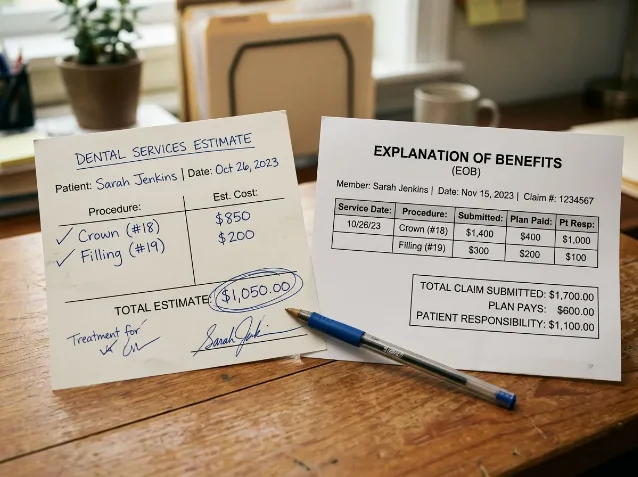
The $1,050 quote that turned into a $1,700 claim. A user on r/personalfinance described getting a root canal followed by a crown within five days. 5 The dentist quoted the crown at $1,050 out of pocket, citing that the $1,000 annual maximum had already been consumed. But the submitted claim was $1,700 — the insurer paid $600, which now eats into the maximum, leaving the pending endodontist bill at risk of running into the cap.
The community explanation is worth internalizing. u/HitPointGamer described what's happening: "My doctors and dentists always submit what I refer to as 'optimistic pricing' to the insurance company. The insurance company caps what they're allowed to charge, however, and then pays the appropriate percentage of the allowed price." In-network contracts set a maximum allowed amount — the $1,700 billed figure is the office's standard fee, not the patient's liability. u/jonnyredcorn put the mechanics plainly: "If your dentist is in network with your insurance they will have a maximum allowed amount that they can charge you which could be the $1,050. They would still bill the $1,700 but after the claim is denied due to maxed benefits they will do a $650 write-off." 5
The practical lesson: when insurance is maxed, ask the in-network dentist to bill at the contracted rate, not the submitted charge. The write-off is already built into the in-network agreement.
Root canal redo denied — and what to do about it. A user on r/HealthInsurance was referred to an endodontist to redo a root canal from 2019 and was told outright that the insurer won't reimburse. 6 The community flagged a common policy structure: root canal limits typically run either "one per tooth, ever" or "one per tooth per 5–10 years." Moderator u/LizzieMac123 noted: "It's common to have a limit to the number of root canals that will be done — either a hard limit like one per tooth, period, or one per tooth per so many years (5–10 years is what I see most commonly)." u/No-Produce-6720 was direct about the appeals ceiling: "Coverage limits, particularly on dental policies, are hard limits, meaning you can appeal, but the policy only covers what it covers, and nothing more." 6 If the redo isn't covered, extraction usually is — the coverage logic around existing vs. new treatment applies differently for removals.
SF dental upselling — 231 comments worth of evidence. The week's highest-engagement dental thread:
콘텐츠 카드를 불러오는 중…
A user with Delta Dental coverage reported their Cow Hollow dentist was "upselling treatments I didn't need, gaslighting me when I denied those treatments, and overcharging me for services that were 100% covered by my insurance and not refunding me (until I called them out on it)." 7 The post drew 210 upvotes and 231 comments, with multiple respondents sharing similar experiences in the Bay Area. u/DigitalMediaLolita reported paying about $15 per filling under 90% Delta Dental coverage at a Union Square dentist. u/TadpoleEducational named a specific Embarcadero Center clinic as having tried to sell "thousands of dollars of work three other dentists have now said I don't need."
The thread functioned as a community-sourced dentist vetting list — useful to any San Francisco reader but also a real-world illustration of why getting a second opinion before proceeding with any treatment plan over $500 is standard consumer self-defense, regardless of city. 7
Dual insurance, one catch: the office kept the refund. A user on r/HealthInsurance has two dental plans — primary through their employer (lower tier), secondary through a spouse's large-company plan (better coverage). The dentist will not submit to the secondary insurer, and insists on holding any secondary reimbursement as a credit on the account. The user paid $600 upfront with major restorative work still to come. 8 It's common for dental offices to decline filing secondary claims — but holding the secondary reimbursement rather than refunding you is not standard practice. If your dentist won't file the secondary claim, you can submit it yourself, and most plans allow the reimbursement check to come directly to the member rather than the provider when the member paid out of pocket first. Ask the secondary insurer's member services line how to request direct reimbursement in writing.
Vision: what Medicare actually pays for eye exams
A thread on r/medicare this week surfaced a point that comes up repeatedly: Original Medicare (Part B) does not cover routine eye refractions — the exam that generates a glasses or contact lens prescription. 9 Moderator u/OleLadyThinker was explicit: "Medicare pays Optometrist and Opthalmologist for certain eye tests that are linked to diseased, illness or injury conditions — it does NOT cover 'eye refractions' — what you get for your RX to correct your vision."
What Medicare does cover: exams tied to diabetes, glaucoma, macular degeneration, cataracts, or eye injuries — and after cataract surgery with an IOL implant, one refraction and one pair of glasses per eye. 9 The uncovered refraction fee typically runs $45–$75, according to commenter u/Revolutionary_Low581. Several commenters noted that some providers code the exam to link it to an existing diagnosis, which can make it reimbursable. That's legitimately possible if a medical condition is documented — the coding has to be accurate, not manufactured.
First-time glasses buyer: what the America's Best math actually looks like
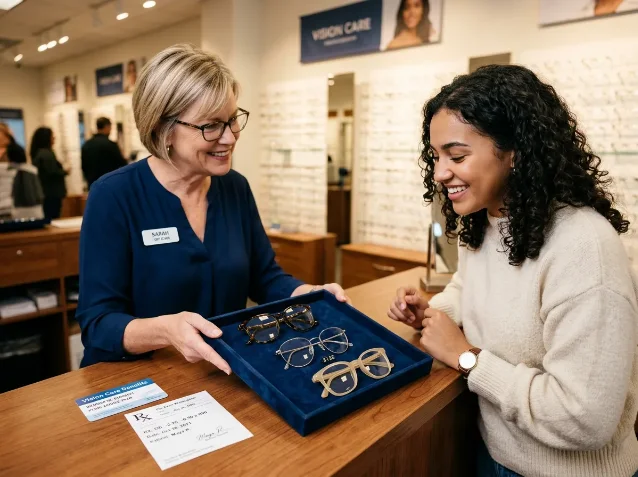
A first-time glasses buyer on r/glasses found the America's Best "2 pairs for $95" deal ran to roughly $200 out the door once upgrades were added. 10 Most other local optical shops didn't accept the insurance. Costco was cheaper per pair but also didn't take the plan, making the out-of-pocket cost $200+ for one pair.
The community tip that's easy to miss: even when a provider doesn't accept your insurance, you can submit a reimbursement form yourself. Most vision plans include a frames and lenses allowance that reimburses a fixed amount regardless of where you bought them — you just have to file. As u/Hyppocamp put it: "You can always submit reimbursement form with your insurance. You should get Frame and lenses credit." 10 Whether this works depends on whether your specific plan has out-of-network reimbursement — check the summary of benefits before assuming it doesn't. Multiple commenters pointed to Zenni as a lower-cost backup for non-prescription-critical pairs: u/Monkey4life-80 reported running 3 Zenni pairs at a similar total cost to one America's Best pair. 10
EyeMed LASIK promo: still live, deadline gone
EyeMed's "$1,200 off LASIK" promotion through the U.S. Laser Network (eyemedlasik.com) is still displaying prominently as of June 15. 11 The June 30 expiration date that was visible in the prior checkpoint has disappeared from the page — no expiration is currently shown. The three partner networks (LasikPlus, The LASIK Vision Institute, TLC Vision) and approximately 600 locations remain listed. The discount applies to EyeMed members using in-network LASIK providers.
Whether the deadline was extended or simply removed is unknown. If you're EyeMed-insured and considering LASIK, the offer appears usable now. Before booking, confirm directly with a partner clinic that the $1,200 off applies to your specific procedure and prescription — high or complex prescriptions are sometimes excluded from promotional pricing.
Procedure pricing benchmarks (updated June 2026)
CostCanal updated all four of its core dental procedure cost pages on June 7, 2026. 12 13 14 These figures represent the uninsured retail range — in-network contracted rates are lower; dental school clinics are lower still.
| Procedure | Self-pay range | Most patients pay |
|---|---|---|
| Preventive cleaning (D1110) | $75–$200 | — |
| Filling — composite (D2391) | $169–$300+ | — |
| Crown — porcelain (D2740) | $800–$2,500 | $1,100–$1,800 |
| Root canal — molar (D3330) | $900–$1,800 (GP) / $1,300–$2,200 (specialist) | ~$1,300 avg |
| Simple extraction (D7140) | $75–$300/tooth | — |
| Surgical extraction | $150–$650/tooth | — |
| Implant — total (D6010 + abutment + crown) | $3,000–$6,000/tooth | — |
For vision, self-pay benchmarks based on GoodRx and industry data: comprehensive eye exam runs ~$136 on average (range: $50 at warehouse clubs to $200+ at private practices), 15 a complete pair of glasses averages ~$350 without insurance, and LASIK runs $1,500–$5,000 per eye with a national average near $2,600. 16
These numbers are useful for two things: checking whether what your dentist or eye doctor quotes is in line with market rates before you say yes, and as a negotiating floor if you're paying cash. A dentist who quotes $2,800 for a crown on a self-pay patient is quoting roughly double the national self-pay ceiling — worth asking for an itemized fee schedule.
Quick toolkit: reducing out-of-pocket this week
- DentalPlans.com JUN26 flash sale — dental savings plan memberships are 15% off through today (June 15) with code
JUN26. 17 Savings plan memberships run $80–$200/year and provide 20–40% off at participating dentists, with no waiting period and no annual maximum. Careington Care 500 starts at $184.95/year for individuals. 18 These are not insurance — they're pre-negotiated discount networks — so they work best when you have a confirmed treatment plan and your dentist participates. - Contact lens rebate structure changed at Lens.com — the central rebates page (lens.com/rebates/) now returns a 404. 19 Manufacturer rebates are now distributed through individual product pages. Clariti 1-Day by CooperVision still offers $50–$300 back depending on pack size via mail-in rebate. 20 If you're due to reorder lenses, navigate directly to the brand product page to find the current rebate form rather than looking for a central hub.
- FAIR Health Consumer for cost lookup — if you want to verify whether a quoted price is above or below market before agreeing to a procedure, fairhealthconsumer.org lets you enter your ZIP code and a dental procedure code (CDT code) to see the 25th, 50th, and 80th percentile rates for your area. 21 Ask your dentist for the CDT code before the appointment if you want to look up fair pricing in advance.
Community stories sourced from r/personalfinance, r/HealthInsurance, r/SFbitcheswithtaste, r/glasses, and r/medicare, June 8–15, 2026. Individual experiences reflect specific plan terms. Verify coverage details, waiting periods, and network participation directly with your insurer before scheduling care.
Cover image: AI generated.
참고 출처
- 1Mass.gov: Learn about MassHealth dental benefits
- 2CostCanal: Dental Crown Cost Without Insurance (2026)
- 3Becker's Dental Review: Class-action lawsuits filed against Delta Dental in 4 states
- 4PacerMonitor: Washington Western District Court — new case filings
- 5r/personalfinance: Dentist submitted claim higher than what I was told
- 6r/HealthInsurance: Dental insurance says they won't cover root canal redo
- 7r/SFbitcheswithtaste: Does anyone NOT have a dentist that scams them?
- 8r/HealthInsurance: Dentist wants to keep reimbursement as credit
- 9r/medicare: Does Medicare cover eye exams?
- 10r/glasses: Is America's Best a good place to get glasses?
- 11EyeMed LASIK: Find a LASIK provider
- 12CostCanal: Root Canal Cost Without Insurance (2026)
- 13CostCanal: Tooth Extraction Cost Without Insurance (2026)
- 14CostCanal: Dental Implant Cost Without Insurance (2026)
- 15GoodRx: Self-pay for eye exams and vision care
- 16Lasik.com: How much does LASIK cost in 2026?
- 17DentalPlans.com: Dental savings plans
- 18DentalPlans.com: Careington plan listing
- 19Lens.com: Rebates page (404)
- 20Lens.com: Clariti 1-Day rebate 2026
- 21FAIR Health Consumer
이 콘텐츠를 둘러싼 관점이나 맥락을 계속 보강해 보세요.