Howard Marks broke 65 days of silence on the day SpaceX priced its IPO
On June 12 — the day SpaceX priced at $1.77 trillion — Howard Marks reappeared after 65 days of public silence on the Prof G Markets podcast. He declined to call the current market a definitive bubble, but walked through 150 years of technological waves to make his point: every one produced a money-losing bubble, and AI's analytical opacity makes this the least tractable he's seen. He called participating in SpaceX, Anthropic, and OpenAI IPOs "closer to speculating than analytical investing" — a "thumb suck" rather than a value analysis — and offered a three-tier AI investment framework for navigating the uncertainty.

Howard Marks, co-founder and co-chairman of Oaktree Capital Management (the world's largest distressed-debt investor, with roughly $193 billion under management), last said anything publicly on April 9, 2026 — an Oaktree memo titled "The Reality of Risk." Then he went quiet for 65 days. On June 12, he picked his moment: the same day SpaceX priced the largest IPO in history at a $1.77 trillion valuation, he appeared on the Prof G Markets podcast hosted by Scott Galloway and Ed Elson, and laid out why this AI moment worries him. 1
Who Howard Marks is
Marks has been writing investment memos since 1990 — the collected body of work, The Most Important Thing, became required reading at Berkshire Hathaway and is on Warren Buffett's short list of recommended books. His firm Oaktree specializes in credit and distressed debt, which means Marks has spent his career studying what happens when optimism runs ahead of repayment capacity. He called the dot-com bubble in a January 2000 memo titled "bubble.com," sent to clients one quarter before the Nasdaq peaked. When he writes, or speaks, the investment community pays attention not because he's consistently bullish or bearish, but because his frameworks age well.
콘텐츠 카드를 불러오는 중…
The 150-year argument
Marks did not walk onto Prof G Markets and say "this is a bubble." He was explicit that he won't make that call. What he did instead was more methodical: he walked through 150 years of technological innovation and asked whether this time might be different.
"If this technological innovation with its exuberance doesn't produce a money-losing bubble, it'll be the first." 1
The precedents he cited: railroads in the 1860s, radio in the 1920s, automobiles, computers in the 1950s and 60s, and the internet in 2000. Each wave was real — the technology worked and changed the world. Each wave also produced a "money-losing bubble" for investors who bought in at peak exuberance. The technology succeeds; many of the investors don't.
His operating rule: "This time it's different is never different." 1
What makes this AI cycle distinctively difficult, in his view, isn't the exuberance — he's seen that before. It's the analytical opacity. Marks is a value investor: his craft is estimating a company's cash flows 5 to 10 years out, applying a discount rate, and comparing the result to today's price. He says AI companies break that process entirely.
"I've never heard anybody tell me exactly what AI will be able to do or when or for whom or how much profit it'll produce." 1
On SpaceX specifically — priced at roughly 100 times revenues and raising $75 billion in the largest public offering ever, on the same day Marks was recording — and on Anthropic and OpenAI, he was direct:
"I don't think there's an analytical or value-based way to decide whether or not to participate in these IPOs, and if so, at what price." 1
He reached for a South African expression to name the process investors are using instead of analysis: "It's what my South African friends call a thumb suck." He added: "If somebody will tell me what they think Anthropic net earnings will be in 2036, I'll bet them that they're not within 50% of the truth." 1
Where Marks thinks you can still invest — and where he won't
Marks is not saying stay away from AI entirely. He laid out a three-tier framework:
- Hyperscalers — Amazon (AMZN), Alphabet (GOOGL), Meta (META), Microsoft (MSFT) — he called "some of the greatest companies I've ever seen," with established moats and large operating cash flows. They're the least risky AI exposure, though probably not the maximum winners if AI booms because their non-AI businesses temper overall growth.
- Established AI companies — Anthropic, OpenAI, Nvidia (NVDA) — carry higher risk but have "high probability of still being successful 5 or 10 years from now." Already operating, unlikely to be displaced entirely.
- Startups with no revenues or no profits — "At the riskiest end of the spectrum, you have lottery behavior. Most people who buy lottery tickets lose all their money. A few people become incredibly rich." 1
He also named sectors he sees as relatively insulated from AI disruption: energy, food production, timber, homebuilding, transportation, metals and mining, chemicals. "Things that have less intellectual content are less likely to be disrupted by AI."
The valuation context he offered: the Shiller CAPE ratio currently sits at roughly 42, near the dot-com peak of 44. The conventional S&P 500 P/E is around 23, against an 80-year average of roughly 16. High, in his read, but not yet at the 2000 extreme of 32. Concerning enough to be alert; not so extreme as to constitute a definitive call. 1
He closed with the tension he won't resolve for you:
"The cautious seldom err or write great poetry." 1
Caution may be the right call. It might also be the mistake of a generation. He said both things and left the choice where it belongs — with the investor.
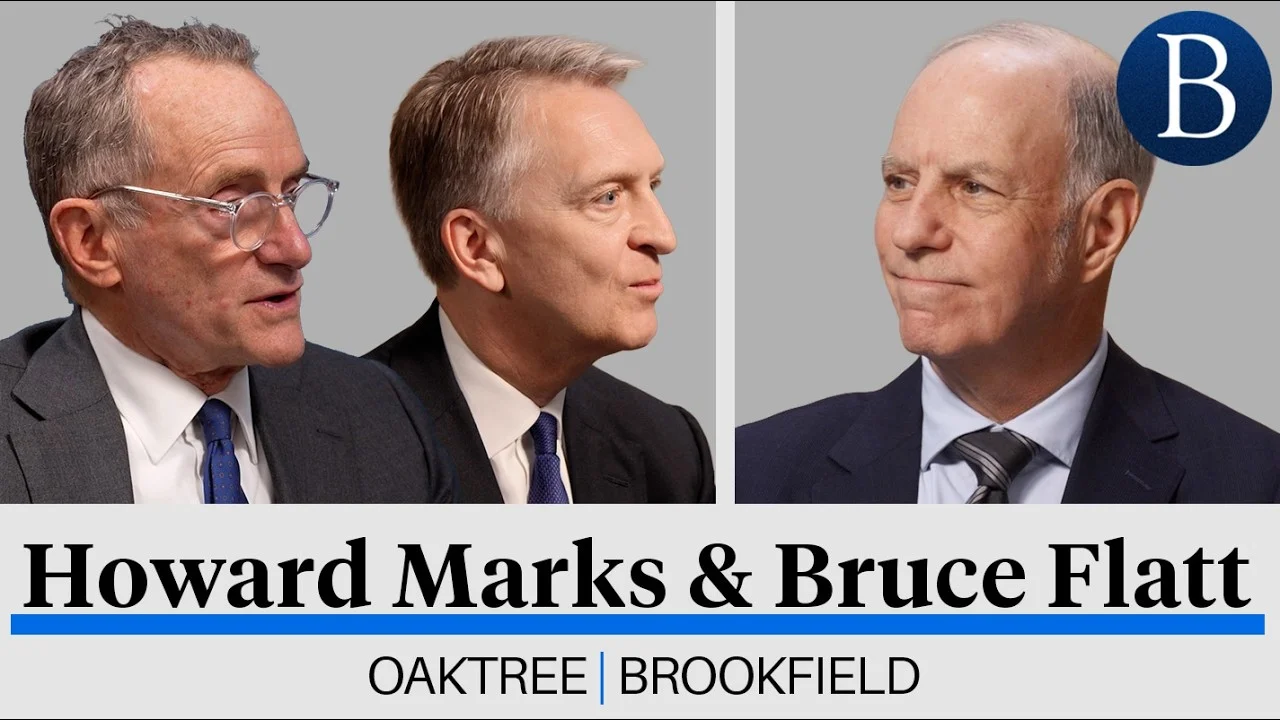
Cover image: Howard Marks and Bruce Flatt in the Barron's "At Barron's" interview, published June 12, 2026. Barron's / YouTube
이 콘텐츠를 둘러싼 관점이나 맥락을 계속 보강해 보세요.